Sara without an H > this collection: Poems > Warm Hands Cold Heart > The Juggler > Form A Queue > Lamé > The Alibi > Attention Seeker > Consider It Brought > Genie In A Jam Jar >> next collection: Fragments Of Hell
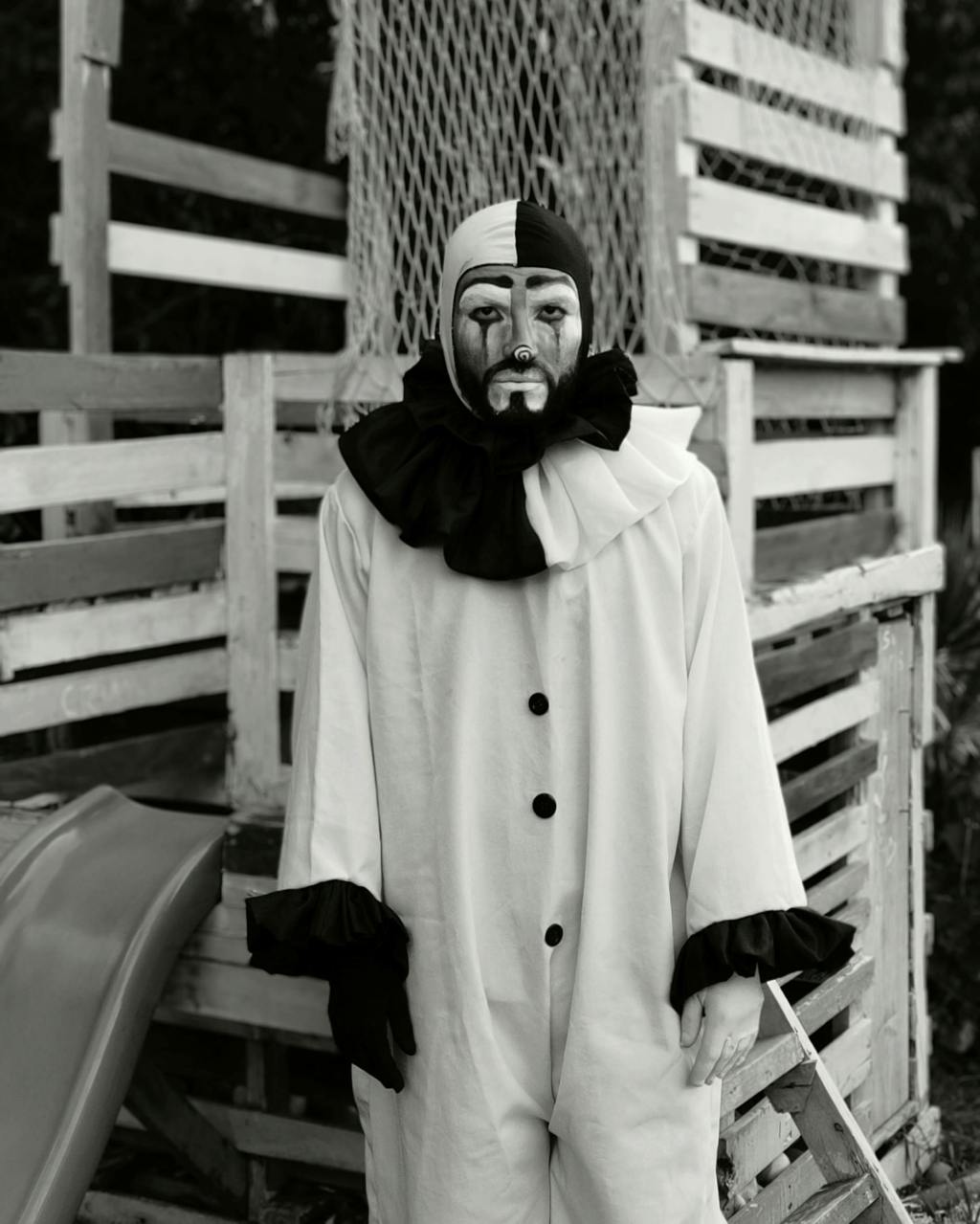
The Juggler
(written 14 May 2014)
At pier's end in a seaside town,
In Brighton, or some place in Kent,
A pensive, pale-faced, Pierrot clown
Is juggling to pay the rent.
And wending his way homeward bound,
Meets somebody who tempts him much,
With magic beans sold by the pound,
Which fortify your dreams, as such,
So Pierrot throws his earnings down;
His money's spent.

He takes his magic beans and climbs
Out on the roof and finds his friend
The moon, and sits and dreams in rhymes,
And hopes the good dreams never end,
And fears the bad dreams might come true.
And wishes hard for Columbine,
Because he knows he'll never woo
Her, and it's easier to pine,
Also aesthetic often-times,
His heart to rend.

Then climbing back inside his room,
Hears Harlequin upon the stair,
His heavy tread and hearty boom,
And doesn't want to see him there,
So hides in silence in his cell,
In contemplation, hermit-like,
And hopes that Harlequin won't tell
Him off for solitude, or psych
Him out... Ignore the voice of doom?
He doesn't dare.

He starts to juggle golden coins,
With one hand tied behind his back,
He concentrates, he girds his loins,
Against predictable attack
From grinning devil Harlequin,
Whose tangled words leave no way out,
Who stirs him up and makes him spin,
Who always peddles seeds of doubt,
Who all his time and peace purloins;
He feels the lack.

He wishes for more magic beans,
Yet knows it won't do any good
To dream all day, by any means,
'Though he would try it, if he could.
'Cause waking up to decadence,
Which used to simply mean "decay",
Is robbing him of any sense
Of right and wrong, of night and day.
He knows that decadence now means...
His neighbourhood.

Pierrot for festival prepares,
With magic beans it feels sublime,
The troupe performs at country fairs,
A ranting, raving pantomime,
Kaleidoscope of tremor, he
Collides with folks from revels past,
But all are robbed of memory,
And every fair is like the last,
And no one notices or cares;
He's killing time.

He's let his hope be ruled by fear,
Withdrawn behind his foolish pride,
But fools have wisdom, vision clear,
Are optimists, eyes open wide.
He primes himself to be a clown,
And ties one hand behind his back,
Then thinks again, starts walking down
Past Punch and Judy, Jumping Jack...
There's hopeful Pierrot on the pier,
His hand untied.


© Sara Nicola Ruth
Sara without an H > this collection: Poems > Warm Hands Cold Heart > The Juggler > Form A Queue > Lamé > The Alibi > Attention Seeker > Consider It Brought > Genie In A Jam Jar >> next collection: Fragments Of Hell
RefLection – 6 Apr 2015
This poem is about a sexual predator who hides behind his lovelorn, party-hard image, ever hopeful that because everyone around him is wasted they either won’t remember or won’t notice his abusive behaviour.
When I wrote this poem nearly a year ago I had been looking at the different representations of Pierrot the Clown in art and literature, where he became in effect the poster boy for tortured artists. Simultaneously, and in total contrast to his place in “high art”, troupes of Pierrot clowns performed comedy routines at seaside towns as entertainment. I was trying to express in my poem this duality between the Pierrot of crass funfair amusements and the Pierrot of introversion, suffering for warped love… I even chucked in some Edgar Allen Poe references for kicks.
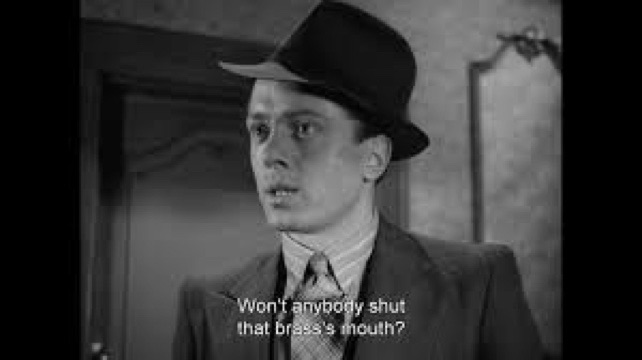
Then I watched Brighton Rock, the 1947 film noir based on Graham Greene’s novel, for the first time in years and realised that not only does a troupe of Pierrot clowns feature in several pivotal scenes of the film but also that Pinkie (played by a very young Richard Attenborough) was evil Pierrot, at the end of the pier with his hand untied but with nowhere else to go but the sea. He hates women, his intentions to them are violent, he only courted and married Columbine to stop her testifying against him for his crimes. Then he tries to persuade her into a suicide pact but this is foiled, she is saved, he jumps.
Pinkie as Pierrot “on the pier, his hand untied” gives the poem the really dark edge I’d intended: he had unleashed all his worst desires and it was his undoing.
background to the poem
PIERROT the clown (or the fool) originated in France in the late seventeenth-century with the Comédie-Italienne and has been explored in the work of many writers and artists over the centuries, played by Sarah Bernhardt, painted by Picasso, appropriated by David Bowie, and is associated with the Decadent movement in art and literature.
the Pierrot of popular taste also spawned a uniquely English entertainment. In 1891, the singer and banjoist Clifford Essex returned from France enamored of the Pierrots he had seen there and resolved to create a troupe of English Pierrot entertainers. Thus were born the seaside Pierrots (in conical hats and sometimes black or colored costume) who, as late as the 1950s, sang, danced, juggled, and joked on the piers of Brighton and Margate and Blackpool.
For Jules Janin and Théophile Gautier, Pierrot was not a fool but an avatar of the post-Revolutionary People, struggling, sometimes tragically, to secure a place in the bourgeois world. And subsequent artistic/cultural movements found him equally amenable to their cause: the Decadents turned him, like themselves, into a disillusioned disciple of Schopenhauer, a foe of Woman and of callow idealism; the Symbolists saw him as a lonely fellow-sufferer, crucified upon the rood of soulful sensitivity, his only friend the distant moon; the Modernists converted him into a Whistlerian subject for canvases devoted to form and color and line. In short, Pierrot became an alter-ego of the artist, specifically of the famously alienated artist of the nineteenth and early twentieth centuries.
In literature, the Decadent movement—late nineteenth century fin de siècle writers who were associated with Symbolism or the Aesthetic movement—was first given its name by hostile critics. Later it was triumphantly adopted by some of the writers themselves. The Decadents praised artifice over nature and sophistication over simplicity, defying contemporary discourses of decline by embracing subjects and styles that their critics considered morbid and over-refined. Some of these writers were influenced by the tradition of the Gothic novel and by the poetry and fiction of Edgar Allan Poe.
Sara without an H > this collection: Poems > Warm Hands Cold Heart > The Juggler > Form A Queue > Lamé > The Alibi > Attention Seeker > Consider It Brought > Genie In A Jam Jar >> next collection: Fragments Of Hell
 Sara Nicola Ruth